Tuesday, January 14, 2014

The Three Try to Steal All the Money, Chapter 1

1: The Girl Who Couldn’t Sleep
When Renee Altka turned five years old, she was no longer able to sleep.
            It didn’t occur exactly on her fifth birthday but rather sometime shortly afterwards. The exact date was lost because at first she and her family regarded it as little more than the insomnia brought on by hyperactivity that afflicts every small child. When a week passed without Renee sleeping a wink her parents took her to a doctor, and as far as he could tell she was just suffering from regular old insomnia. He gave her family a mild sedative to help her re-adjust to a regular sleep schedule and that seemed to work for everyone except Renee.
            Truth be told, all the drugs did for Renee was make her loopier than usual. She would swallow one of the little blue pills then lie in bed and stare at the ceiling for the entire night, a routine that continued well after she ran out of pills. Each morning she would watch the sunrise and at breakfast before school her parents would ask her how she’d slept. She always told them she’d slept fine - out as soon as her head hit the pillow – because it was far easier than telling them the whole truth. Then her parents would ask Renee about her dreams, which were always so vivid and colorful, and when Renee answered this question she didn’t have to lie, at least not totally. Her dreams were always recounted with exquisite detail because she still had those, and they were far livelier than any of the dreams she’d had in the first five years of her life.
             Rather than inhabiting the odd and varied landscapes of her mind, the creatures and objects that Renee dreamed of would occupy the space around her. A cat with three tails and the ability to speak the language of the Easterners would curl up at the foot of her bed. A woman with a fox for a head wearing an intricately decorated shawl would sing an ethereal melody, accompanying herself for the harmonies. There would be a man dressed in the same top hat and suit worn by the carnival barker at the town refinery’s fair every year, but instead of encouraging people to pitch in for the raffle he would simply laugh to himself while detaching and reattaching his right arm. At first Renee was worried all these apparitions would wake up her mother and father, but no matter how loud they were her parents never betrayed any suspicion that they’d heard weird noises coming from her room.  Every night a cavalcade of images and creatures would parade through Renee’s room as she lay on the bed and watched them go, occasionally throwing a pillow at them and watching as it sailed through their incorporeal forms.
            Aside from the nights Renee’s life was otherwise perfectly normal. She went to school, made friends, tried to talk to boys, and liked to read despite her town being small enough and distant enough from the Central Line that books were hard to come by. Rather than severely impairing her, her sleeplessness merely imbued her with a slightly loopy air. Sometimes she’d be asked what time it was and reply that her begonias were fine, thank you very much, before snapping back to reality and checking a clock. Occasionally she’d get into the habit of simply stopping in the middle of the street and staring off into space, but this rarely lasted more than half a minute. As far as Renee was concerned, being regarded as slightly weird was a small price to pay for being able to function on no sleep at all.
            One day when she was sixteen, one of her classmates kissed her. Tommy wasn’t the cutest kid in her year, but he wasn’t half-bad looking, and he seemed nice enough to boot. This all would have been fine if the kiss hadn’t happened immediately after lunch with about half the school watching, and even that would have been bearable if Tommy hadn’t followed the kiss by wheeling around and yelling, “Dave, you owe me two coins! I kissed the crazy girl! Pay up!”
            After suffering through the rest of school, Renee didn’t go with her friends to The Fountain for sweet drinks like they usually did. She also didn’t run home to bawl her eyes out into her pillow. For reasons she couldn’t entirely explain, Renee somehow found herself on Sentinel Hill overlooking the town. She took shelter beneath the solitary tree that was the hill’s namesake, planted after the guard tower that used to reside there was torn down some hundred years ago. While the willow shaded her from the afternoon sun Renee reflected on the town below. The tiny town, home to around five hundred people living in the shadow of the Carlson Slime Refinery where her father and half the other fathers in town worked, and whose newer generations would forever regard her as the crazy one. No matter what work she took on or what passions she pursued, her unique condition ensured that her title among the denizens of Carlson’s Landing would be Renee the Crazy Girl who just wasn’t right in the head.
            When Renee did allow herself to cry, she felt something brushing up against her cheek to wipe away the tears. The three-tailed cat purred and whispered something to her she didn’t understand. She blinked, rubbed her eyes, and saw the cat was still there, joined now by a baby-sized man in green pajamas squatting in the grass nearby and producing cans of beans from his pockets. Renee considered this for a moment as she scratched the cat behind its ears, then stopped and realized what she was doing. The cat looked up at her, its eyes almost as wide as hers, and meowed, “Jiaozi?”

            Renee dropped the cat and scrambled over to pick up one of the tiny cans of beans and found that it rested comfortably in the palm of her hand. She threw it at the tree and examined the chip of bark it knocked off the trunk. Renee smiled.

            At first she didn’t steal anything major. A cake or two from the bakery. Some extra fried potatoes from another customer at The Fountain. Food was easiest both because it was small enough and because the cat was her most willing accomplice in this regard, at least once the language barrier was overcome and she could assure him that he’d receive a portion of the profits. After a few months Renee could even control which dreams manifested. Her friends grew more distant as she spent less and less time with them, preferring to head from school straight to Sentinel Hill. The stares and whispers she received in the halls and streets didn’t matter as much to her anymore thanks to all the new and interesting friends she could spring forth from her head.
            A couple years later when Tommy asked her to the final school dance it was something of a surprise, and the giddiness it engendered was enough to keep her aloft for the rest of the week. The joy and shock settled down the night of the dance as the hours dragged on and Renee found herself sitting at her kitchen table, waiting for a knock on the door and passing the time by playing cards against the fox-headed woman. Rather than endure her parents returning to find her sitting alone at home she stormed to the school and burst into the gymnasium to find the dance in full swing.
            She brushed past her friends as they tried to speak to her and stormed over to where Tommy was holding another girl in his arms right in front of the band. At first he regarded her quizzically, but as memory kicked in a smile spread across his face. At last he couldn’t help himself and burst out into laughter, clearly amused by the idea that anyone would ever want to ask her to the dance. He found himself joined by the chuckles and jeers of his friends nearby. Renee couldn’t contain herself, but just as she was about to cry her head split open. It was different from the dull aching pains which she’d grown well accustomed to over the years. The sharp pain reverberated through her skull and as she clutched her temples a tall man with no face and clad in a dark suit strode out from the crowd and walked slowly but purposefully towards Tommy. The band stopped playing and the entire crowd turned to see this man approach a now pale Tommy and place a hand on his trembling shoulder.

            Renee redoubled her efforts and as she focused through the migraine the man in the suit disappeared. The gym was silent as Renee collected herself, started to say something, then thought better of it and made for the door. She took no chances that night. Before her parents or anyone else could hear of what happened she packed her things, grabbed what little money she’d saved in her sock drawer, and ran off down the street. When she reached the top of Sentinel Hill she stopped and regarded the small lights of Carlson’s Landing, hazy through the smoke that rose from the slime fields. A bird with rainbow plumage flapped down to perch on the tree branch above her and regarded her with its opal eye. When it took flight again along the course of the Kraslow River, she followed it for years.

Wednesday, December 18, 2013

Call of Duty: Ghosts ABRIDGED


Call of Duty: Ghosts was a game that initially aroused none of my interest. After five straight games in as many years, I was burned out on the franchise. But the more I heard about this latest iteration the more ridiculous it seemed. It couldn't really be that over the top and xenophobic, right? I mean most of the other COD games are less jingoistic than they appear on the surface, at least overtly. My curiosity ultimately got the better of me, and I decided to watch a play through of the game, both because the series really has gotten to the point where the player's presence is ancillary to the whole experience and because I couldn't find a copy to rent anywhere near me. What I saw confirmed that yes, actually, it's not just as bad as you might have heard, it's worse.
The result is what you see before you, with much apologies to The Editing Room.

CALL OF DUTY: GHOSTS ABRIDGED

Friday, October 4, 2013

Update: XCOM is Kicking my Ass


The reason I don't watch much TV at all is because for me, video games are my TV. Instead of knocking out a few episodes whenever I have some downtime, I like to spend an hour or two playing a video game. It feels more active and there are plenty of games structured in episode-esque chunks. When I get a new game though I tend to play through the whole thing over the course of a weekend or two. Partially this is because most single player narratives are still structured like a movie or book and are more continuous, but it's also due to simply enjoying the novelty of a new experience.

About a week ago I bought XCOM: Enemy Unknown off the Xbox Live Marketplace since it was on sale. Yesterday instead of continuing my (sixth) campaign to save Earth from the alien scourge, I opted to replay another game. A simpler game. A less soul-crushing game.


Wednesday, September 18, 2013

Auteurs, Metal Gear Solid, and Dumb-Smart Games


So what about that Grand Theft Auto V, huh? With all the cars and the guns and whatnot. Sure looks fun. Probably the last big game of this generation, and from one of the most interesting and story-driven development studios ever.

But who cares about all that noise? I just finished the Metal Gear Solid HD collection on my Xbox so we're going to talk about that instead.


From hiimdaisy's "Let's Destroy the Shagohod!"

See, there are few things I feel as confused about as I do about Metal Gear Solid. I love to play it and talk about it despite the fact that I think pretty much every game in the series is deeply flawed.

Saturday, August 17, 2013

The Future Has Happened/Is Happening/Will Happen


This summer a few things happened to me that, though unconnected on their surface, have combined to produce a prolonged bout of introspection. Also, I don't have a job yet, so I just have too much time to think about this stuff.

The things that happened are:

1) I graduated college,

2) I engaged in a very heated discussion alongside a classmate of mine against my mom and a couple of her friends, and

3) I re-played Deus Ex: Human Revolution.


The first one is pretty self-explanatory, as there has been no shortage of puff pieces in numerous publications about how simply being a part of my generation means that I'm an entitled and ineffective burden on society, which is not exactly the way to boost the confidence of a new generation eager to enter the real world and start contributing to it.

The second thing was a bit more complicated, and lasted pretty much for the entire dinner. But I'll try and break it down here. Essentially, my mom and her friends (who were about her age) were arguing with me and a classmate of mine from high school who's just a couple years younger than me. The debate revolved around the older people's conception that our generation has, on the whole, less meaningful relationships and ways of communicating, due in large part to technology. We tried to counter with arguments like "technological change has always happened and has always shook up culture, like the printing press" and similar stuff but by the end of it we seemed no closer to convincing them. What's more I had a similar conversation around the same time between my grandparents and my best friend and I. I got the sense from both of these conversations that the older people felt the changes being wrought by our generation's use of social media and other such technologies was unprecedented for the changes being wrought upon our social landscape, and what's more such changes were unquestionably terrible overall in their effect on our development and lives.

And the third thing up there perfectly encapsulates where I was coming from in those debates (it helps that I was in the middle of my playthrough when that conversation happened). Deus Ex: Human Revolution is a game not just set in the future, but about the future, much like the way Far Cry 2 handles war. But where Far Cry 2 had a very definite message about war, Deus Ex's element of personal choice allows it to do more than just deliver one message, or even multiple messages. Deus Ex basically puts you into a very well-crafted world with its own political problems and actors and lets you decide how to respond.


In 2027, human cybernetic augmentation has become widespread, basically just this side of mass commercialization. The consequences of this development are widespread and manifold. On the one side are advocates of the technology who see it as the next step in human evolution. Embracing technological change on this scale is not just necessary for our development as a species, but is in essence our destiny, the culmination of hundreds of years of scientific progress. On the other hand, there are many who fear the dangers human augmentation can bring with it. Granting unnatural strength and abilities to everyone unchecked may do little more than usher in a Hobbesian nightmare of constant war, all against all, where the richest citizens who can afford the technology and drugs necessary to sustain its use can triumph over the lower classes, presuming they don't just chuck cars at them in an effort to be done with the whole thing more quickly. And then there are those in the shadows who see a future in the technology, albeit one carefully structured and controlled according to what they perceive as humanity's best interests.


Deus Ex exposes you to these viewpoints by placing you into a world where they already exist and letting you explore. As you read e-mails, books, and digital newspapers and overhear conversations by people on the street (not to mention occasionally getting involved in their problems), you manage to get a sense of where proponents of every argument are coming from. On the one hand, your boss David Sarif, head of a leading producer of augmentations, is adamant about the good this technology can do in the world and the opportunity it offers humanity as a species to transcend its mere physicality. On the other hand, he engages in shady practices all the time, occasionally asking you to join in as he displays a stark mentality of the ends justifying the means. Bill Taggart, the head of the anti-augmentation lobby, has supporters who are so extreme that they frequently resort to terrorism in opposition to the spread of this new technology. But then you get on his PC and read an e-mail from a woman about how his book and message managed to help her turn her life around and get back on track after a bout of suicidal depression.


At its core, the story and world of Human Revolution is about the societal tensions that arise when progress occurs, which is to say all the time. Change is never neat and never wholly bad or good. It is messy and different, and those are about the only constant things one can say about the process. And frankly, I feel that message rings a lot more true than "things now suck because they were just better back in my day". But what elevates the game is that it does give you the option to reject this progress. Choice is an integral part of the game, from how you talk to people to how lethally you want to approach situations. The view the game has of the central issue isn't made explicitly clear, and the player is left to draw their own conclusions. If Deus Ex does have one singular message, it's "Be Adaptable", which is made very clear by the last level of the game, which represents a stark change in gameplay from the entire rest of the game. If you've been dead-set on one particular playstyle for the whole game, you will be thrown for a loop for the last hour or so.

It's not like what I'm experiencing now is anything new. Generational debates have happened pretty much ever since there was more than one generation around. As Grampa Simpson said "I used to be 'with it'. But then they changed what 'it' was. Now what I'm 'with' isn't 'it' and what's 'it' seems weird and scary to me...it'll happen to you." But this divide has never been more apparent than right about now, as technological developments occur in such rapid succession that generational divides are not only deeper than they've ever been, but can occur even more frequently. And games like Deus Ex offer an interesting and constructive lens with which to approach these sorts of discussions. On the one hand, we can yell at each other until we're blue in the face about the precise value of Twitter to society at large. Or we could realize that change isn't necessarily good or bad. It simply is, and always has been. It shouldn't be demonized or glorified outright, but recognized as a constant which must be approached with a measured and calm mind.

A measured and calm mind that can invent arm-blades you can use to pull off sweet takedowns.

Monday, June 24, 2013

The Man of Steel, Not Of Tomorrow


(THERE ARE TOTALLY SPOILERS FOR MAN OF STEEL IN HERE)

If you look over the last few posts in this blog reaching all the way back to September, you'll notice a couple of themes which sort of overlap. They're basically:

A) People are hungry for (and are producing) new and interesting takes on old stories, probably due to the absolutely bonkers amount of media available in modern life.
B) Many big budget movies and games of a genre that frequently paint the protagonist (and the player) as a shining beacon of heroism have started to question that role. See: DMZ, Zero Dark Thirty, Spec Ops: The Line.

It's pretty obvious how these themes can overlap, and together they add up to a lot of media that are primarily concerned with deconstructing whatever it is they're depicting. This means critically examining aspects or tropes of a work that people usually take for granted and trying to apply them to something more closely resembling reality. The result usually is not-strictly speaking-fun, though when done well it can be quite engaging. In some cases it can even perform a necessary function, as when Spec Ops managed to make a lot of video game players and creators realize that maybe making games where the central mechanic is shooting people in the head as realistically as possible isn't the best way to depict heroism.


As far as comics go, the gold standard for deconstruction was Watchmen. It presented an alternate universe where superheroes exist as a fact of life, eventually being outlawed as vigilantes, and these heroes were in turn depicted as people who turned to that life due to ridiculously messed-up personalities. The comic also featured Dr. Manhattan (the blue guy in the picture up there), the only character in this altered history with actual superpowers. He's depicted as a god in the story, and his mere existence is enough to tip the scales of the Cold War in the 80s much farther than they ever went in real life. A character in the book remarks, "The superman exists, and he's American." Later he admits that this statement was altered from its original content, with "superman" standing in for his original phrasing, "God".

So, Man of Steel.

Sunday, May 12, 2013

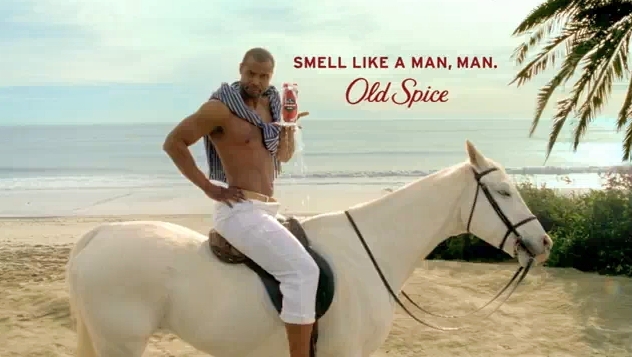
Why Old Spice Wins at Marketing


If you are reading this blog, then you have seen this ad. That is just a statistical fact, and ordinarily I don't trust math, because it's performed by people who are interested in math, and therefore clearly have something deeply, intensely wrong with their brains. Those people should go see a brain doctor at once.

Anyway, that ad. It was just the first of many. It showed up 3 years ago and blew everyone away to such an extent that they're still going strong. All of these ads feature ridiculous effects and sharp writing that serve to get one message across clear as day: Use Old Spice and you will be the manliest of men. And we, the makers of Old Spice, know this.

It's that second part that is key to the success of Old Spice's marketing. Most other ads that take this tack, both before and after the revelation that was "The Man Your Man Could Smell Like", have tried to use the first part to varying effect. As an example, I would offer up every ad for pickup trucks ever made. It's a truism of advertising that you aren't just selling a product, you're selling an idea. When people make a decision to buy something they consider the act a sort of personal statement, and brands naturally recognize this. This is why successful marketing manages to tap into feelings that can transcend the obvious trappings of the product being sold. I don't watch sports, let alone soccer, but Nike has made tons of commercials centered around the game that I consider among my favorites of all time. This isn't just because of their impressive production values or the novel concepts they have as their premises. It's because they realize that soccer can be about so much more than just kicking a ball around a field. The ads are really about things like success being earned and not just granted, or how at the end of the day, our future is ours to determine.

Most ads, of course, aren't quite so high minded. Selling pick up trucks requires an emphasis on the fact that this truck is going to make you strong and powerful because it is big. That's about it. When they have done something similar to those Nike ads, they're still about how tough the people who buy (and make) these trucks are. Take a good long look at that commercial. It's selling an idealized vision of a lifestyle that has become marginalized in real life by agribusiness and gigantic factory farms, but the vision of a hardscrabble, salt of the earth farmer is so ingrained in the popular subconscious that the commercial can effectively use it as a shorthand for manliness, which they then link to the truck. The message is clear: buy a Ram pickup, and you will be as rough and tough as these grainy pictures we're flashing across the screen.

Old Spice, on the other hand, realizes there are more and more people becoming more aware of the tricks of the trade of marketing. The solution to this conundrum isn't self-deprecation: people aren't going to buy something if you tell them it's crap, because you're making it, so you would know better than anyone. The solution, rather, is to go in the exact opposite direction as hard as you can. Underlying all of the Old Spice commercials is the tacit acknowledgement that yes, the idea that a body spray can grant you the physique of a god is ridiculous. But that idea is also so hilarious that it becomes ripe for parody in a cavalcade of outrageous and hilarious commercials.

Old Spice ads don't just grab people's attention through their overload of images and crazy concepts. They speak to a self-awareness that is permeating a lot of the media that absolutely saturates our culture. Their philosophy is to take the implicit claims of other "manly" marketing campaigns and make them explicit, which manages to both defuse and win the argument at the same time. Ram can't claim with a straight face that buying one of their trucks will imbue you with the spirit of centuries of wizened cattle ranchers, but they can very heavily imply it. Old Spice explicitly says that using their body spray will enable you to win all the first place medals and live forever through your line of premium table crackers. My roommate once noted that a lot of commercials are just weird from an objective standpoint, because they're set in a world where the product being advertised is the most important thing in the life of the characters involved. Having bad teeth in a commercial for toothpaste is basically asking to be thrown in jail for making children everywhere burst into tears every time you open your ugly mouth. Old Spice takes this to its logical conclusion by making the men who use it in commercials into mythical heroes who can turn tickets into diamonds because they smell so good.

You just can't beat that. Being ridiculous on that same level for your product won't really work, because Old Spice already did that (and did it pretty much perfectly), and most other traditional ads pale in comparison. The Old Spice ads are brilliant because they manage to be almost perfect satires of a lot of other commercials, and even if you don't catch on to this, they still work because they're so well made and written. Old Spice has managed to both deconstruct and reconstruct the idea of marketing products as "manly", a feat that could obviously be accomplished only by a man who smells like freshly cut wood being used to build a boat for conquering the deadliest ocean.

Okay, I lied. Dos Equis does it well, too. You know what, forget everything I just wrote up there. The key to selling products is a deep voice. Get a dude with a deep, powerful voice, and everyone will buy whatever you're selling. There, done. Marketing: Solved. You're welcome, New York.